
HALF A MILE THROUGH THE ICE.
In January 2013, an expedition team achieved the first clean hot-water access through 800 metres of West Antarctic ice into Subglacial Lake Whillans. Operating at the core of the thermal heating system were six Alkota pressure-washer units.
The Surface Is Only the Beginning
Subglacial Lake Whillans is an active subglacial hydrological body situated beneath the Whillans Ice Stream in West Antarctica (84.24°S, 153.64°W). Positioned beneath approximately 800 metres (half a mile) of compressed glacial ice, the lake lies in total darkness, under immense overburden pressure, isolated from direct contact with Earth’s atmosphere for thousands of years.
For polar scientists led by the WISSARD (Whillans Ice Stream Subglacial Access Research Drilling) consortium, reaching this environment was a top priority. However, access had to be clean. Traditional mechanical coring techniques risked introducing petroleum lubricants, drilling muds, and non-sterile surface microbes into an ancient subglacial aquatic ecosystem. Only a sterile, high-output hot-water drilling system could melt an access pathway without chemical contamination.
800 Metres Through Glacial Ice
SURFACE CAMP / FIRN LAYER
Sastrugi surface, ambient -25°C to -35°C polar desert
COMPACTED GLACIAL ICE
Firn-to-ice transition zone, porous crystal structures
HIGH-PRESSURE DEEP ICE SHEET
Solid monolithic ice under immense overburden pressure
BASAL ICE INTERFACE
Thermal boundary zone, basal melting and shear friction
SUBGLACIAL LAKE WHILLANS
First clean human access — pristine subglacial aquatic environment
As the drill head melts down through the 800-metre ice column, warm water must constantly circulate back up the borehole to prevent the sub-zero ice walls from instantly re-freezing and seizing the drill string. Six Alkota pressure-washer units provided the reliable continuous heat required to keep the borehole clear until penetration was achieved.
The Engineering Problem
Melting a 30-centimetre diameter borehole through 800 metres of ice requires monumental continuous thermal energy. Every litre of water pumped down the drill stem loses heat rapidly to the surrounding sub-zero ice walls. If the thermal flow rate drops or the heating core falters, the borehole quickly freezes closed, trapping valuable sensor packages and drill heads.
Furthermore, the drilling water itself had to meet strict international clean-access protocols. Sourced from melted Antarctic snow, drill water was routed through multi-stage filtration to 0.2 microns, irradiated with ultraviolet sterilisation systems, and brought to high temperatures before being pumped under pressure to the drill nozzle.
Six Alkota Machines
To generate the immense thermal transfer required for the WISSARD hot-water drill, the University of Nebraska–Lincoln engineering team selected Alkota industrial pressure-washer systems. Specifically, six Alkota 12257K systems were integrated into the primary Heater Pump Units (four units in HPU-1 and two units in HPU-2).
Published engineering literature in the Annals of Glaciology records that each Alkota unit was capable of delivering approximately 45 litres per minute (around 12 GPM) while increasing water temperature by approximately 52°C. When all six Alkota units were available for drill-water production, the combined system could theoretically generate up to approximately 270 litres per minute of clean hot water at approximately 90°C.
In operational field practice, drilling flow was commonly lower because some units were simultaneously tasked with snow melting and reservoir heating. The continuous-wound Schedule 80 coil design and robust slow-turning pump architecture enabled these standard industrial units to operate without failure throughout the campaign.
Published system figures describe the Alkota heater units as components within the larger University of Nebraska–Lincoln WISSARD Clean Hot Water Drill System. Operational flow varied according to drilling, snow melting and water-production requirements.
What Alkota Actually Did
Alkota equipment did not independently drill through 800 metres of Antarctic ice, nor did Alkota lead the scientific mission. The Clean Hot Water Drill was designed, manufactured, and operated by the University of Nebraska–Lincoln Science Management Office and its research partners under National Science Foundation funding.
Alkota supplied the six standard industrial pressure-washer heating units that UNL engineers integrated into the containerised Heater Pump Units. Alkota’s role was providing the hydraulic pressurisation and continuous thermal energy conversion that powered the hot-water drilling stream.
The Traverse Across the Ross Ice Sheet
Before a single litre of hot water could be pumped, the entire drill infrastructure had to be transported across the Antarctic wilderness. The WISSARD equipment traverse travelled approximately 625 miles (1,000 kilometres) from McMurdo Station across the Ross Ice Sheet to the remote drill site at Lake Whillans, departing on 30 December 2012 and arriving on 12 January 2013.
Contemporary University of Nebraska reporting describes 13 Caterpillar tracked tractors towing 26 ski-mounted modules carrying more than 500,000 pounds of specialised drill gear, generators, laboratory containers, fuel bladders, and the Alkota heating skids over crevassed terrain and wind-scoured sastrugi.
625-Mile Ross Ice Sheet Traverse
Assembly of 13 Caterpillar tracked tractors & 26 ski modules
Crevasse radar navigation and fuel cache verification
Camp established — Alkota heating skids deployed for borehole melt
Data verified against published University of Nebraska–Lincoln Science Management Office expedition traverse reports and WISSARD logistics publications.
Breakthrough into the Subglacial Lake
On 28 January 2013 local Antarctic operating time (27 January in the United States), after days of continuous thermal melting, the sensor package on the drill stem registered a sudden pressure transition. The hot-water drill nozzle had broken through approximately 800 metres (half a mile) of West Antarctic ice into Subglacial Lake Whillans.
The borehole was approximately 30 centimetres in diameter. The achievement represented the first successful clean access through the Antarctic ice sheet into a subglacial lake. Scientists subsequently recovered pristine water and sediment samples through the borehole.
From Fabrication to Nature Discovery
Drill Engineering & Fabrication
Engineering and assembly of the WISSARD Clean Hot Water Drill begins by the University of Nebraska–Lincoln Science Management Office and partners.
Transport & Staging in Antarctica
Drill modules and Alkota heating skids transported by vessel to McMurdo Station and prepared for overland ice transit.
Breakthrough into Subglacial Lake Whillans
The clean hot-water drill completes penetration through approximately 800 metres of glacial ice into the subglacial lake.
Pristine Sample Recovery
Water and sediment samples successfully recovered through the clean-access borehole and transferred for laboratory analysis.
Peer-Reviewed Scientific Findings (Nature)
Research published in Nature (Christner et al.) confirms a diverse, metabolically active microbial ecosystem living in Subglacial Lake Whillans.
What the Samples Revealed
The breakthrough in January 2013 was only the beginning. Water and sediment recovered through the clean-access borehole were subsequently preserved, catalogued, and subjected to rigorous laboratory analysis by the WISSARD science team.
In August 2014, peer-reviewed scientific research published in Nature (Christner et al.) reported a diverse community of metabolically active microorganisms within Subglacial Lake Whillans. The research concluded that aquatic environments beneath the Antarctic ice sheet can support viable microbial ecosystems living in total darkness, drawing energy from mineral and chemical reactions rather than sunlight.
A Microbial Ecosystem Beneath the West Antarctic Ice Sheet
Christner, B. C., Priscu, J. C., Achberger, A. M. et al. · Nature, Vol. 512, pp. 310–313 (21 August 2014) · DOI: 10.1038/nature13667
Read the Research on Nature.comThe Point Isn’t Antarctica.
The Point Is the Standard.
The value of this story is not that every UK industrial operator needs polar drilling equipment. It is that Alkota machinery was chosen to form the heating core of one of the most demanding engineered thermal systems ever deployed.
The exact engineering qualities that proved vital in Antarctica are what industrial operators rely on every day across Britain:
Your application is different.
Let’s engineer around it.
Explore our commercial and bespoke mobile platforms across heavy plant, facilities, agriculture, marine, and oilfield sectors.
Antarctic Deployment Technical Parameters
Data verified against UNL Science Management Office & Cambridge University Press Annals of Glaciology
Verified Academic & Engineering References
The Schedule 80 Hot-Water Technology
Direct access to the Alkota engineering systems referenced in this field study.
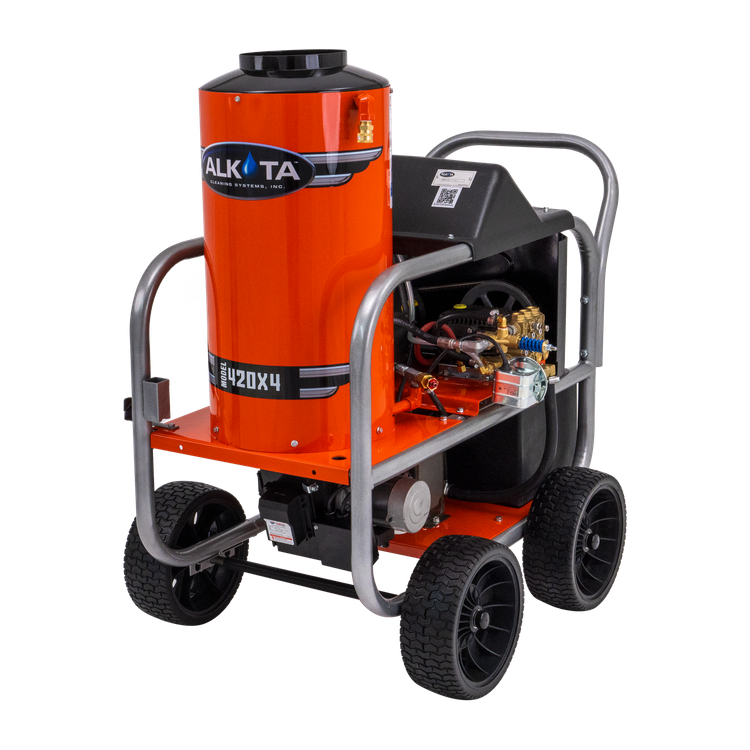
Alkota 420X4
420X4 — Electric Driven Oil Fired Hot Water Pressure Washer
Your Job May Not Involve 800 Metres of Ice. The Engineering Principle Is the Same.
Whether melting a subglacial borehole or degreasing heavy plant in a UK quarry, dependable hot-water thermal capacity is non-negotiable. Discuss your industrial requirements with Alkota UK engineers.

One Great Northern × Alkota | Heavy Plant Cleaning Case Study
WHEN THE MACHINES ARE THE BUSINESS.
Crane hire and heavy plant don’t get the luxury of staying clean. They have to arrive on site ready to work. The cleaning system therefore becomes part of the operational infrastructure.