
WHEN THE DIRT IS PART OF THE JOB, CLEANING BECOMES ENGINEERING.
Oilfield and heavy industrial equipment can encounter crude oil, grease, drilling mud, paraffin, bitumen, soil and other difficult contamination. The cleaning system has to be specified around the contamination, equipment and operating environment.
This isn’t a cosmetic clean.
It’s a reset between jobs.
Heavy industrial machinery operating across drilling sites, pipe lay yards, refineries, and processing plants encounters extreme hydrocarbon contamination: thick crude oil, synthetic polymers, bentonite drilling mud, paraffin waxes, and abrasive mineral scale.
In these environments, cleaning is an essential engineering step that resets equipment between operational cycles. It allows non-destructive testing (NDT) on drill string threads, enables rapid visual inspection of hydraulic manifolds, clears clogged mud screens, and prepares heavy capital plant for safe transport and redeployment.
- Thread & NDT Inspection: Stripping heavy pipe dope down to bare metal for crack detection.
- Thermal Degreasing: Melting stubborn paraffin waxes and bitumen with 95°C water.
- Mud Displacement: High volumetric flow (21–30 L/min) to carry dense barite slurry away.
- Turnaround Readiness: Preparing plant skids for swift redeployment between project contracts.
Some dirt doesn’t want to leave.
The industrial contamination stack.
Industrial contamination is governed by complex chemistry and high-melting-point physics. Cold water and extreme pressure alone merely spread viscous hydrocarbons into wider, slippery films.
Heavy Crude & Bitumen
Dense hydrocarbons with high molecular weight. Requires 85°C–95°C hot water to lower viscosity and break stubborn surface adhesion bonds.
Paraffin Wax & Pipe Dope
Waxy compounds and zinc/copper thread lubricants that solidify at ambient temperatures. Demands saturated vapour steam (140°C) to flash into liquid state.
Synthetic Drilling Mud
Non-Newtonian mixtures of bentonite clay, barite weighting solids, and synthetic polymers. Requires high water flow volume (18–25+ L/min) to float heavy solids.
Heavy Mechanical Grease
Waterproof lithium/calcium greases mixed with grit around open gearboxes, drawworks, and slewing rings.
Mineral Scale & Rust
Hard calcium carbonate deposits and ferrous corrosion crusts on drill casings and pipe racks requiring calibrated rotary nozzles.
Field Soil & Sediment
Abrasive mineral sediment and compacted mud accumulated across mobile plant undercarriages, crawler tracks, and transport trailers.
When contamination changes viscosity,
heat changes the equation.
Viscosity in petroleum hydrocarbons is thermally dependent. As temperature rises from 15°C to 85°C, the kinematic viscosity of heavy oil drops by orders of magnitude, turning stiff, adhesive tar into a free-flowing liquid.
Alkota continuous Schedule 80 heating coils deliver sustained 90°C water at full trigger pull, while our saturated steam generators produce 140°C vapour. This thermal energy liquefies waxes and asphalt instantly, allowing water flow to carry the emulsion away with minimal chemical consumption.
*Specific temperature settings depend on contamination melting thresholds, substrate coatings, and safety procedures.
Effective for loose mud and sediment. Ineffective on paraffin wax, bitumen, and heavy crude.
Melts heavy crude, mechanical grease, and pipe dope. Cuts cleaning time by two-thirds.
Flashes high-melting-point waxes and asphalt into liquid state with minimal water volume.
Pressure is force. It isn’t the whole process.
Loosening is only half the job.
Pressure
Mechanical cutting force. Breaks surface adhesion without pitting parent metal or stripping critical protective coatings.
Flow Rate
Flushing volume (L/min). Carries heavy drilling mud solids, barite slurry, and emulsified oil away into recovery channels.
Thermal Heat
90°C thermal energy. Liquefies waxes, lowers oil viscosity, and accelerates detergent surfactant kinetics instantly.
Chemistry / Dwell
Targeted industrial degreasers. Pre-softens bitumen bonds to minimise mechanical wear and operator fatigue.
Industrial does not mean
hazardous-area approved.
Oil and gas facilities incorporate strictly classified hazardous zones (e.g. ATEX Zone 0, Zone 1, and Zone 2) where flammable gas, vapours, or mists may occur during normal operations.
Standard industrial pressure washers and burner skids feature open electric motors, ignition systems, and diesel combustion chambers. They are not intrinsically safe or explosion-proof certified.
Alkota equipment must only be deployed in unclassified non-hazardous areas, designated pipe yards, or under strictly supervised site-specific Hot Work Permits issued by the responsible operating company.
Check hazardous zone drawings. Pressure washers must be positioned in unclassified safe zones.
Ensure spark arrestors, emergency stops, and low-water cutoffs are operational.
Obtain required Hot Work Permits and establish continuous gas monitoring prior to starting.
Water and Fuel Become Logistics Problems
On remote drilling pads, pipeline spreads, and storage yards miles from mains infrastructure, calculate your total fluid requirements and payload impact.
Requires dedicated daily bulk water tanker replenishment or connection to heavy site buffer reservoir.
*Illustrative calculation assuming continuous trigger pull. Actual field consumption depends on operator duty cycle and unloader bypass time.
What comes off the machine
doesn’t disappear.
Industrial wash water containing crude oil, toxic drilling polymers, or heavy mechanical degreasers must never be discharged onto ground soil or allowed to enter surface waterways.
Alkota closed-loop recovery solutions deploy vacuum recovery surface cleaners, heavy-duty impermeable containment bunds, and multi-stage oil-water separation skids to capture 100% of effluent for licensed transfer and disposal.
Always assess site-specific environmental discharge licenses and implement containment sumps prior to washing.
Drive-over chemical-resistant berms that create instant wash bays on remote drilling pads.
Continuous suction heads that extract dirty water directly into onboard holding tanks.
Multi-stage filtration removing free oils and suspended solids down to legal discharge thresholds.
The trailer becomes the wash bay.
The 12-stage Alkota bespoke engineering lifecycle for remote industrial field rigs
The Bespoke Rig Architecture
Requirement & Operational Audit
Defining the operational envelope
We evaluate your daily target surfaces, contract commitments, towing vehicle capacities, and operational shifts to establish baseline requirements.
Remote work punishes weak equipment.
The part you don’t have is the part you need.
When equipment operates on remote drilling sites or pipeline spreads hours from technical support, fragility is fatal. Equipment must be serviceable with standard mechanical tools.
Alkota machines eliminate complex computer circuit boards in favour of heavy-duty electro-mechanical switches, external brass unloader manifolds, and 1,450 RPM ceramic plunger pumps. Our continuous Schedule 80 ASTM A53 seamless steel coils survive violent thermal expansion, backed by Alkota UK’s national spare parts inventory.
- Replacement unloader valve cartridge & seal kit
- High-pressure hose repair joiners & quick-release O-rings
- Assorted high-pressure spray nozzles & steam nozzles
- Diesel fuel filter water-separator cartridge
- Spare ignition electrodes & burner photocell
Specify the System Around the Contaminant
Select your equipment type, primary hydrocarbon contamination, and field deployment environment.
Alkota 4305XD4 Extreme-Duty Hot Water Skid
Delivers continuous 95°C water with high-pressure saturated steam capability (140°C), low-RPM ceramic plunger pump, and heavy continuous Schedule 80 coil for heavy crude, bitumen, and pipe dope.
Oilfield Operating Parameter Framework
Standard engineering parameters recommended for drilling tubulars, mud pumps, and heavy petrochemical skids
Recommended Equipment for Oilfield & Heavy Industry
Direct access to the Alkota engineering systems referenced in this field study.
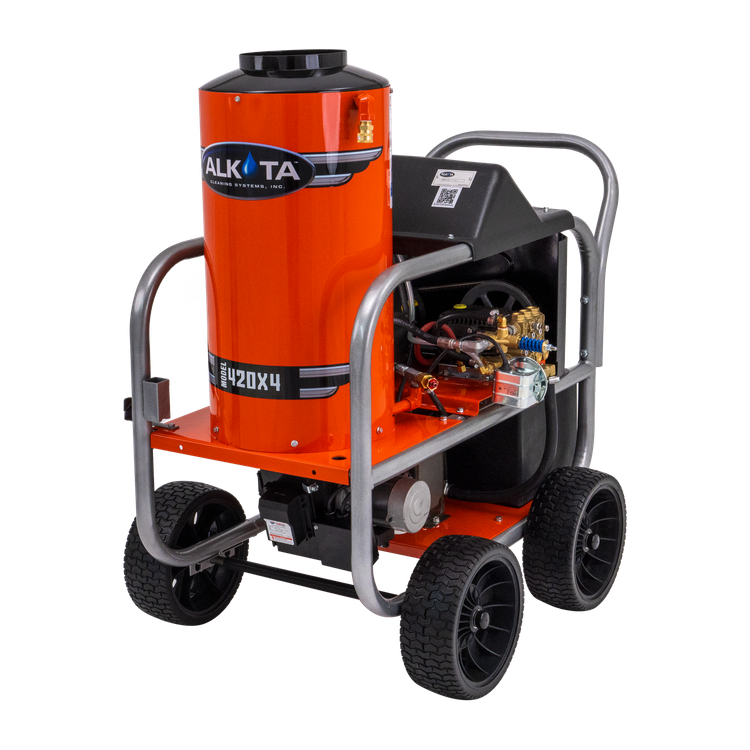
Alkota 420X4
420X4 — Electric Driven Oil Fired Hot Water Pressure Washer
Oilfield Equipment FAQ
When the Site is Remote, the Contamination is Heavy and the Equipment Can’t Afford to Wait, Specification Matters.
Tell Alkota what you clean, where the system will operate, what contamination you face, how much water is available and how mobile the system needs to be.

Bespoke Pressure Washer Trailers & Mobile Wash Systems | Alkota UK
THE JOB DEFINES THE MACHINE.
Every cleaning operation has different constraints. Water, power, mobility, duty cycle, contamination and workflow all change what the right system looks like.