
WHEN CLEANING IS THE BUSINESS.
For professional industrial cleaning teams, pressure-washing equipment has to do more than produce pressure. Heat, flow, duty cycle, serviceability and uptime all affect what can be achieved on site.
A domestic machine costs money when you buy it.
A professional machine costs money when it stops.
For a commercial cleaning contractor or facilities management provider, pressure washing machinery is not merely a utility stored in a van. It is a revenue-producing production asset. Every hour spent on site is directly linked to labour cost, customer satisfaction, and contract margin.
When a lightweight machine falters — struggling to produce continuous hot water, suffering pump cavitation, blowing delicate unloader seals, or requiring repeated slow passes across grease-stained concrete — the economic loss is immediate. Professional contractors require equipment engineered to operate under continuous duty cycles without interruption.
- Lukewarm Water: Smearing oily binders instead of emulsifying them.
- Inadequate Flow: Loosening dirt without sufficient volume to flush it away.
- Thermal Cutout: Intermittent duty cycles forcing idle operator downtime.
- Fragile Components: Plastic unloader bodies cracking under pressure spikes.
- Repeated Passes: Burning costly labour hours to achieve an acceptable standard.
EntireFM
Facilities Management & Industrial Cleaning · UK Operations
EntireFM provides integrated facilities management, specialist building maintenance, and comprehensive industrial cleaning services across commercial property portfolios throughout the UK.
Their specialist industrial teams are called upon to handle demanding external hardstanding, distribution centre loading bays, warehouse floor deep cleans, and factory decommissioning projects where standard commercial cleaning methods prove inadequate.
The job changes. The requirement doesn’t.
Typical commercial cleaning environments encountered by facilities contractors
Warehouses & Hubs
Extensive internal concrete floors, loading dock levellers, and distribution bays marked by heavy forklift tyre scuffs and pallet friction.
Service Yards & Aprons
Large external concrete aprons, trailer parking hardstanding, and fuel delivery islands contaminated with diesel residue and road films.
Plant & Equipment
Fixed manufacturing plant footprints, conveyor drive assemblies, and compactors requiring high-temperature degreasing during maintenance shutdowns.
Building Exteriors
Commercial cladding panels, entrance canopies, structural steel frames, and perimeter brickwork affected by traffic soot and organic staining.
Back-of-House Zones
Refuse stores, recycling compounds, grease-trap access areas, and service corridors demanding thermal sanitisation and odour control.
Decommissioning
Lease-end dilapidation cleans and factory restorations where years of oil soakage and chemical deposits must be removed to bare substrate.
Dirt isn’t one material.
Neither is the solution.
Treating every commercial surface with cold water and maximum pressure is ineffective and risks damaging substrates. Professional industrial cleaning requires matching thermal energy, flow volume, pressure, and chemical dwell to the specific molecular profile of the contaminant.
Hydrocarbon Oils & Grease
Gearbox weeping, motor oil, and hydraulic films. Requires 80°C–90°C thermal breakdown to reduce viscosity and lift from porous concrete.
Hardened Rubber Tyre Burns
Forklift friction deposits in warehouse aisles. Demands concentrated rotary surface pressure combined with hot water to soften rubber binders.
Atmospheric Carbon & Soot
Diesel particulate and industrial fallout on cladding. Requires alkaline chemical pre-treatment and wide-fan medium-pressure rinsing.
Organic Biofilms & Slime
Algae, moss, and food residues in wet service corridors. Thermal water aids sanitisation and kills spore roots without aggressive biocide runoff.
Pressure is only one number.
The cleaning industry often over-indexes on pump pressure (PSI / BAR). In reality, professional cleaning productivity is governed by the balanced interaction of four fundamental physical variables.
Pressure
Mechanical cutting force. High enough to shear surface bonds, but calibrated to avoid etching concrete or stripping protective paint coats.
Flow Rate
Flushing capacity (Litres per Minute). Flow floats loosened contamination away. Without high volume, dirt simply settles back onto the surface.
Thermal Heat
Thermal emulsification. 80°C–90°C water transforms solid grease and sticky oils into easily rinseable liquid emulsions instantly.
Time / Output
Labour velocity. Balancing pressure, flow, and heat dramatically increases square metres cleaned per hour, protecting project profit margins.
Cold water moves dirt.
Hot water can change the contamination.
In the right industrial cleaning application, heating water to 80°C–90°C fundamentally alters the physical state of the contaminant. Petroleum oils, animal fats, tyre waxes, and fuel residues have high melting thresholds.
When cold water hits heavy grease, it spreads the oily layer into a wider film. Hot water melts the hydrocarbon binder into an emulsion, allowing standard flow to wash it cleanly into drainage channels. This materially reduces physical scrubbing time and enhances the effectiveness of cleaning chemicals.
The job doesn’t stop after twenty minutes.
Commercial cleaning contractors do not run machines for brief 15-minute bursts. An industrial warehouse floor deep clean or a logistics depot washdown frequently demands 6 to 8 hours of continuous, multi-operator trigger time across weekend shutdowns.
Consumer pressure washers use high-speed direct-drive pumps (2,800+ RPM) with aluminium heads and thin coils that overheat under sustained loads. Alkota machines are built with low-speed (1,450 RPM) ceramic plunger pumps and heavy Schedule 80 steel coils designed for true 100% continuous industrial duty.
Lower crankshaft speed cuts heat build-up and seal friction, extending packing life for thousands of operating hours.
Heavy-wall continuous coil withstands violent thermal cycling and hard-water scale without cracking.
Modulating combustion system maintains target water temperature even during continuous dual-lance trigger pulls.
Double-wall air-jacket design cools outer surfaces while preheating burner intake air for thermal efficiency.
Arrive. Set up. Clean. Move on.
A professional industrial cleaning site workflow
01 / Assess
Survey substrate integrity, identify contamination types, locate drainage points, and evaluate electrical/water hookup availability.
02 / Control
Establish safety barriers, protect sensitive electrical junction boxes, and position drain bunds or vacuum recovery dams.
03 / Pre-Treat
Apply targeted industrial degreasers or detergents to thick oil pools or tyre burns, allowing calibrated chemical dwell time.
04 / Heat
Fire the Alkota Schedule 80 burner and calibrate water temperature (75°C–90°C) according to the contamination profile.
05 / Clean
Execute overlapping passes using rotary flat-surface cleaners for open concrete or calibrated hot-water lances for machinery edges.
06 / Rinse
Use high volumetric water flow to flush suspended solids, emulsified oils, and loosened grit towards collection points.
07 / Recover
Operate vacuum recovery systems or oil-water filtration where environmental site regulations prohibit untreated surface runoff.
08 / Verify
Conduct quality walk-through with site facilities managers to confirm surfaces meet contract cleanliness specifications.
09 / Reset
Reel in high-pressure hoses, drain water filters, conduct post-op checks, and stage the rig ready for the next deployment.
The expensive machine is the one that stops the job.
When professional cleaning machinery breaks down in the middle of a commercial contract, the purchase price difference between an entry-level washer and an industrial machine evaporates in minutes.
Contractors face idle labour hours, rescheduled night shifts, emergency hire expenses, customer frustration, and potential penalty clauses. Alkota designs machinery around lifecycle reliability: serviceable components, standardized plumbing, and heavy-gauge construction that eliminates premature machine write-offs.
What Are You Actually Paying For?
Built to be worked on.
Industrial machinery should never require an engineering degree or proprietary diagnostic software to perform routine maintenance. Alkota builds open-chassis frames where all critical wear items — unloader valves, fuel filters, burner electrodes, pump packings, and oil drains — are immediately accessible with standard hand tools.
Supported by Alkota UK’s national servicing network and comprehensive inventory of replacement pumps, coils, burner motors, and seal kits, contractor equipment is maintained in the field for continuous revenue generation.
- External unloader valve and plumbing for quick replacement
- Instant access to fuel filter water-separators
- Clear-sight oil dipsticks and low-level engine shutoffs
- Standardised BSP fittings compatible with UK industrial accessories
The machine is only half the workspace.
In large commercial facilities, dragging 300kg pressure washers across warehouse floors or through tight pedestrian gates causes fatigue and site hazards.
Professional contractors position the machine centrally or in a mobile trailer, deploying 30m to 60m of continuous non-marking hot-water hose via heavy-duty stainless steel live reels. This eliminates machine movement, reduces setup time, protects customer surfaces, and streamlines pack-down.
Clean deep warehouse floors without relocating the machine.
Live swivels and friction brakes keep hoses tidy and organized.
Prevents black rubber scuffs on clean industrial screeds.
Rewind 60m of hot hose in under two minutes.
Heat. Pressure. Chemistry.
Where does the water go?
Certain industrial contaminants require chemical assistance. By integrating Alkota professional detergents with hot water, chemical reaction rates double for every 10°C rise, allowing contractors to use lower chemical concentrations while achieving pristine degreasing.
Additionally, professional exterior cleaning demands environmental compliance. When working on sites without interceptor drainage, contractors use vacuum recovery shrouds or portable wastewater dams to manage trade effluent responsibly.
Site environmental requirements vary and appropriate drainage controls should always be assessed prior to commencing work.
Alkota Industrial Chemical Systems
Formulated for high-temperature pressure washing: heavy alkaline degreasers, traffic film removers, and food-grade detergents.
Explore Alkota Cleaning ChemicalsClosed-Loop Recovery Options
Vacuum recovery surface cleaners that extract dirty wash water directly into onboard holding tanks for licensed disposal.
Explore Recovery SystemsWhat productivity actually means.
Machine performance is only one component of commercial job profitability
Reel-fed plumbing and quick-couple fittings get water on target in minutes.
High L/min and 90°C heat cover maximum square metres per hour.
Surface cleanliness achieved on the first pass without second-day return visits.
Continuous duty cycles ensure crews finish on time during fixed window shutdowns.
Contractor Deployment Parameters
Equipment specifications for commercial facilities management and industrial contract cleaning
EntireFM Verification File
Recommended Equipment for Facilities & Industrial Cleaners
Direct access to the Alkota engineering systems referenced in this field study.
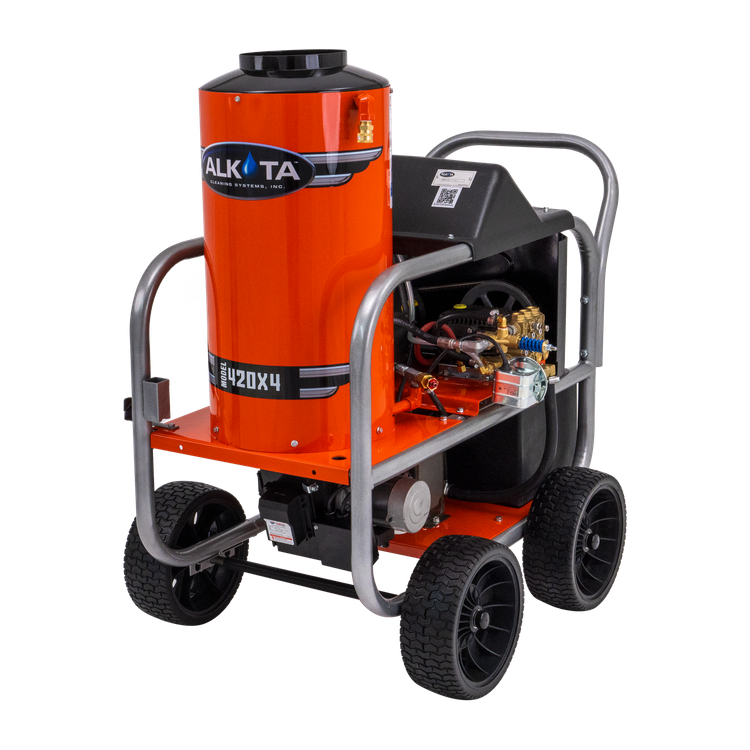
Alkota 420X4
420X4 — Electric Driven Oil Fired Hot Water Pressure Washer
Your Pressure Washer Shouldn’t Just Clean. It Should Earn.
Tell Alkota what you clean, how often you use the machine, what contamination you encounter and how your operation works. We can specify the system around the job.

Professional Pressure Washers for Cleaning Contractors | Commercial Field Guide
BUILT TO EARN ITS KEEP. EVERY DAY.
When pressure washing becomes a business, equipment choice stops being about maximum PSI and purchase price. Productivity, heat, flow, serviceability, downtime and lifecycle cost start to matter far more.