
BUILT TO EARN ITS KEEP. EVERY DAY.
When pressure washing becomes a business, equipment choice stops being about maximum PSI and purchase price. Productivity, heat, flow, serviceability, downtime and lifecycle cost start to matter far more.
The machine isn’t an expense.
It’s the thing you send out to earn.
A pressure washer used occasionally at home can be replaced without serious consequence if it fails on a Saturday afternoon. A commercial cleaning contractor’s machine operates in an entirely different commercial reality.
It is booked onto client sites with strict completion deadlines, transported daily across varied road conditions, operated by multiple team members, and expected to run continuously for 6 to 8 hours against heavy industrial contamination. In that environment, equipment specification stops being about purchase price and starts being about productive output and downtime protection.
- Fixed Access Windows: Overnight or weekend shutdowns where work must complete on time.
- Severe Contamination: Heavy grease, fuel stains, chewing gum, and industrial biofilms.
- Employee Operation: Machinery built to withstand varied user handling without delicate failure points.
- Transport Stress: Continuous road vibration and varying water supply qualities.
Stop buying PSI. Start buying productivity.
The pressure washing market has historically trained buyers to look at a single metric: maximum PSI. In contract cleaning, headline pressure is only one variable in a complex hydraulic and thermodynamic equation. Real contractor productivity is governed by a complete system.
Balanced mechanical cutting force and volumetric flushing capacity.
80°C–90°C hot water to melt hydrocarbons and activate chemistry.
30m–60m live reels to clean expansive areas without machine moves.
Baffled buffer tanks to prevent pump cavitation on weak mains.
Vacuum recovery and interceptor drainage compatibility.
Low-RPM ceramic triplex pumps and Schedule 80 seamless steel coils.
Alkaline degreasers and surfactants calibrated for hot water.
Quick-couplings and roller guides that save 30–45 mins per site.
Pressure breaks it free.
Flow gets it gone.
Pressure (BAR / PSI) is mechanical cutting force. It provides the energy required to shear surface adhesion bonds, strip loose paint, or blast compacted grit out of textured tarmac. However, extreme pressure without adequate water volume simply pulverises dirt in place.
Flow Rate (Litres per Minute) is the volumetric vehicle that carries loosened contamination away from the work area into drainage channels. In large-area commercial cleaning (such as car parks, block paving, and warehouse floors), high flow rate is what allows operators to maintain high square-metre coverage rates without stopping to chase slurry.
180 – 250 BAR (2,600 – 3,600 PSI)
The ideal range for commercial cleaning. Sufficient force to cut surface dirt and chewing gum without risking substrate damage, aggregate fracturing, or mortar blowout.
15 – 21+ Litres / Minute
High-volume water throughput required to drive 20"–24" stainless steel rotary surface cleaners and float suspended mud and tyre slurry continuously.
When the dirt contains oil, heat matters.
Not every job needs a burner.
Thermal Degreasing & Emulsification
Water heated to 80°C–95°C reduces the viscosity of petroleum oils, diesel residues, kitchen greases, and tyre waxes instantly. It melts chewing gum and accelerates chemical detergent reaction rates, dramatically cutting labour time on forecourts, drive-thrus, and industrial yards.
High-Volume Hydraulic Washdown
For loose mud, agricultural soil, clay, dust, and general aggregate rinse washdown, heat provides little mechanical advantage. Cold-water machines focus 100% of input power into high volumetric flow rate with zero burner overhead, lower weight, and simpler setup.
One hour a month and eight hours a day are not the same job.
Consumer pressure washers are rated for intermittent duty: 15 to 30 minutes of running followed by cool-down periods. Their high-speed direct-drive pumps (2,800+ RPM) generate intense internal heat, causing pump packings and brass manifolds to degrade rapidly under sustained loads.
Alkota industrial machines are engineered for 100% continuous duty cycles. We utilise slow-turning (1,450 RPM) ceramic plunger pumps coupled via belt drives or heavy gearboxes, oversized crankcases holding copious oil volumes, and heavy Schedule 80 continuous steel heating coils that withstand thousands of thermal expansion cycles without metal fatigue.
Cuts seal wear and internal heat by 50% compared to direct-drive consumer pumps.
Seamless construction backed by a 7-year coil warranty against thermal stress.
Eliminates heat pitting and scoring under continuous multi-hour trigger pulls.
Separated from pump head for lower thermal stress and immediate 10-minute replacement.
The cheapest machine can become the most expensive one you own.
When evaluating commercial pressure washers, purchase price represents only a fraction of total operating cost over a 3-to-5-year horizon. Equipment downtime on commercial sites cascades into cancelled jobs, idle operators, emergency hire charges, and damaged client reputation.
What does downtime actually cost you?
When a pressure washer fails during a booked commercial job, the financial impact extends far beyond the price of a replacement pump. Calculate your annual exposure from idle labour and lost billing capacity.
*Illustrative commercial model. Real contractor uptime depends on planned maintenance intervals and build metallurgy.
When it wears, can you fix it?
A small part can stop a big job.
Professional cleaning equipment should be fully maintainable, not disposable. High-pressure pumps, burners, and unloaders are mechanical machines subject to wear. When a seal wears after 1,500 hours, an operator should be able to replace the £30 packing set on site rather than scrapping the entire machine.
Alkota machinery features open steel chassis construction where every maintenance component — pump oil sight glass, fuel water-separator, burner electrodes, unloader valve, and thermostat — is immediately accessible with standard hand tools.
- Spare unloader valve & quick-couple manifold
- Assorted calibrated high-pressure spray nozzles
- Rotary surface cleaner replacement spray bar & nozzles
- Quick-release O-rings and high-pressure hose joiners
- Replacement diesel fuel filter and inline water strainer
The job might be 80 metres from the van.
In commercial exterior cleaning, dragging heavy machinery up stairs, over kerbs, or through pedestrianised zones wastes time and introduces site risk. Professional contractors park their vehicle or trailer at a central location and deploy long hose runs.
However, hydraulic friction causes pressure loss over long distances. Using a standard 3/8" internal diameter (ID) hose over an 80m run at 21 L/min can introduce a friction loss of 25–35 BAR. For extreme runs, specifying a 1/2" ID high-flow hose preserves working pressure at the lance.
*Estimated values based on standard smooth-bore hydraulic hose friction tables.
Where does the machine live?
Van-Mounted Skid
Enclosed within a 3.5t commercial panel van. Provides excellent security, weather protection, and urban manoeuvrability.
Towable Trailer Rig
Dedicated high-capacity platform carrying 1,000L–1,500L baffled water tanks, twin live reels, and generator power.
Static Plant Skid
Fixed installation in a dedicated wash bay or boiler room, piped to multi-bay overhead boom drops.
1,000 litres of water weighs about a tonne.
The best machine is useless without water.
Water logistics are the most overlooked operational factor in mobile pressure washing. A standard UK commercial panel van has a total legal payload of 1,000kg to 1,400kg. Filling a 1,000L tank immediately consumes 1,000kg of payload before factoring in the weight of the pressure washer, fuel, hose reels, operator, and tools.
Furthermore, customer mains taps often supply only 10 to 12 L/min. Running an 18 L/min industrial washer directly from a weak tap leads to pump cavitation and damaged valves within minutes. An onboard baffled buffer tank (500L–1,000L) with a low-pressure float valve bridges this gap, allowing continuous cleaning.
*Always verify vehicle gross vehicle weight (GVW) and axle limits prior to configuring onboard water tanks.
- Internal Baffles: Prevents dynamic water surging during vehicle braking and cornering.
- Float Valve Automation: Automatically tops up reservoir without manual monitoring or overflow.
- Multi-Stage Filtration: 50-mesh inlet strainers prevent sediment and rust from reaching pump seals.
- Low-Water Cutoff Switch: Automatically shuts down burner and pump if reservoir empties.
The water doesn’t disappear
when it leaves the nozzle.
In the UK, commercial surface runoff containing petroleum hydrocarbons, chemical detergents, or heavy industrial particulate cannot be legally discharged into surface water drains without interceptor separation.
Professional contractors win high-value corporate and facilities management contracts by offering vacuum recovery systems. Alkota recovery shrouds extract dirty wash water directly at the cleaning head, pulling effluent back into onboard holding tanks for licensed disposal.
Site environmental regulations vary. Always inspect site drainage schematics and establish containment controls prior to washdown.
Enclosed rotary cleaners fitted with perimeter vacuum suction rings that eliminate overspray and recover 95%+ of wash water instantaneously.
Rapidly deployable chemical-resistant containment barriers that block stormwater grates and create localized recovery sumps.
Multi-stage sediment traps and oil-absorbent filtration cartridges for closed-loop wash bay operations.
The smallest part can change the whole machine.
The lance isn’t always the fastest tool.
Nozzle Calibration
Nozzle orifice size dictates operating pressure at a given flow. An oversized nozzle causes pressure drops; an undersized nozzle forces the unloader into bypass.
Rotary Turbo Nozzles
Combines 0° impact force with a rotating 25° cone pattern. Essential for removing hardened mortar, heavy rust, and tree root ingress on hard stone.
Rotary Flat Surface Cleaners
Twin spinning spray nozzles enclosed in an 18"–24" stainless steel dome. Maintains consistent stand-off distance and cleans flat hardstanding 4x faster than a wand.
Don’t build your workflow around the machine.
Build the machine around your workflow.
When a contractor business scales to multiple team members, running two separate small pressure washers from separate vans multiplies vehicle overhead, fuel costs, and maintenance points.
Alkota engineers high-output multi-operator platforms delivering 30 to 40 L/min of 90°C hot water. Fitted with dual unloaders and independent hose reels, two operators can clean simultaneously from a single trailer rig — doubling site square-metre velocity.
- Dual 60m live stainless steel hose reels
- Integrated 1,000L baffled water storage
- Onboard generator power & LED site worklights
- Chemical softwash dosing injection manifold
- Winter antifreeze recirculating bypass loop
Specify the System Around Your Work
Answer four basic operational questions to determine the optimal configuration for your commercial cleaning workflow.
Alkota Towable Hot-Water Trailer System
Designed for commercial contractors tackling expansive paving, plant yards, and chewing gum. Integrates baffled water storage with industrial hot-water power.
Before you buy, ask these 12 questions.
Review these twelve operational criteria before investing in commercial cleaning machinery.
Contractor Equipment Parameter Framework
Standard engineering parameters recommended for commercial pressure washing and surface restoration
Recommended Equipment for Professional Cleaning Contractors
Direct access to the Alkota engineering systems referenced in this field study.
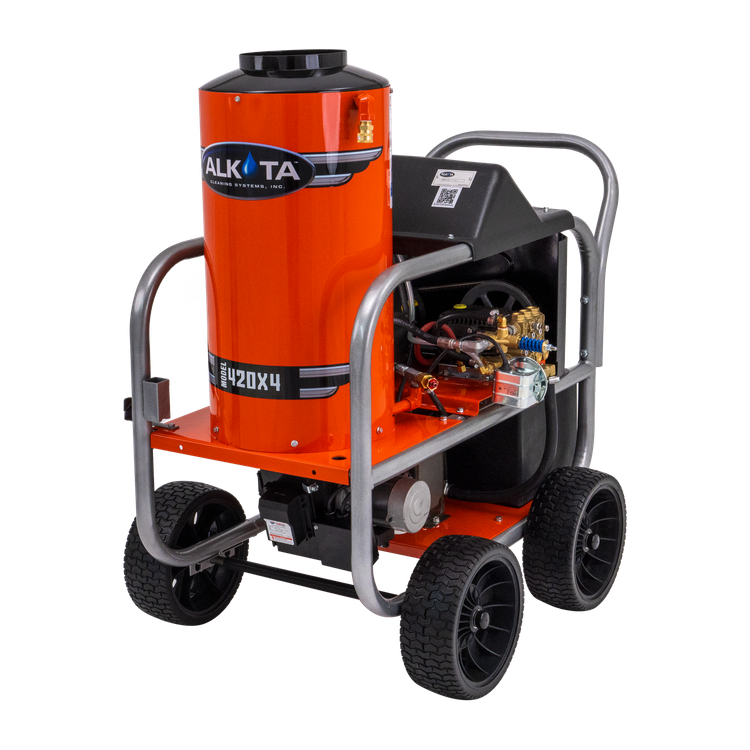
Alkota 420X4
420X4 — Electric Driven Oil Fired Hot Water Pressure Washer
Contractor Equipment FAQ
If the Machine Makes You Money, Specify It Like Business Equipment.
Tell us what you clean, how many hours you work, where the machine operates and how you transport it. Alkota UK will help specify the system around the work.

Agricultural Pressure Washers & Farm Machinery Cleaning | Alkota UK
MUD. OIL. MANURE. THEN DO IT AGAIN TOMORROW.
Agricultural equipment works in conditions designed to make cleaning difficult. Mud, grease, organic contamination, crop residue and oils build up around machinery that still has to be inspected, maintained and put back to work.