
MUD. OIL. MANURE. THEN DO IT AGAIN TOMORROW.
Agricultural equipment works in conditions designed to make cleaning difficult. Mud, grease, organic contamination, crop residue and oils build up around machinery that still has to be inspected, maintained and put back to work.
A tractor doesn’t get dirty for show.
It gets dirty because it works.
Agricultural machinery operates in one of the most mechanically abrasive and biologically aggressive environments on earth. Tractors, combines, telehandlers, and implements work immersed in compacted clay, caustic livestock manure, corrosive silage juices, hydraulic oil weepage, and fine crop chaff.
In farming, washing machinery is not a cosmetic luxury. It is a vital maintenance discipline that prevents engine overheating during harvest, enables rapid visual leak inspections, protects paintwork from acid etching, and supports biosecure animal health protocols. When cleaning equipment fails, it stalls the operational rhythm of the entire farm.
- Cooling Efficiency: Clearing radiator packs to prevent costly harvest engine shutdowns.
- Pre-Service Inspection: Revealing hydraulic weeping, pin wear, and chassis stress cracks.
- Corrosion Defence: Stripping caustic manure and fertiliser salts from chassis steel.
- Biosecurity Preparedness: Removing organic matter prior to approved disinfectant applications.
The machine that cleans the machines.
The agricultural capital equipment an industrial washing system must handle
Deep mud in dual tyres, axle seals, front link linkages, and cab filters.
Chaff build-up, rotary screen dust, sieve decks, and grain tank augers.
Silage clamp grease, boom slide pads, steer axles, and headstock pins.
Compacted seedbed clay, disc bearings, packer rollers, and coulters.
Caustic animal waste, vacuum pump housings, and splash plates.
Chemical rinse cycles, boom washdown, and induction hopper cleaning.
Brake dust, road spray, tailgates, and hydraulic tipping rams.
Dairy parlours, calf pens, handling races, and feed barriers.
It isn’t just mud.
The agricultural contamination stack.
Farming soil is not a single uniform material. A tractor collects layers of heavy clay, baked hydraulic oil, corrosive manure acids, plant sugars, and road film. Different soils require fundamentally different hydraulic and thermal responses.
Compacted Field Mud & Clay
Dense, cohesive clay packed between dual wheels and under chassis belly plates. Demands high volumetric flow rate (18–25+ L/min) to lift and carry heavy solids away.
Grease & Hydraulic Oil Weepage
Hydrocarbons around loader pins, quick-release couplings, and PTO gearboxes. Cold water merely smears it; hot water (85°C) melts the oil binder instantly.
Manure & Caustic Livestock Waste
Highly acidic and organic biological deposits. Requires immediate washdown to prevent paint corrosion, followed by dedicated biosecurity disinfection protocols.
Crop Residue, Chaff & Silage
Fibrous plant material that binds around cutterbars and packs cooling radiators, creating acute fire risks during dry summer harvest windows.
Road & Traffic Film
Oily bitumen residues and road grime accumulated when hauling grain trailers between remote farm holdings and central drying plants.
Fertiliser & Chemical Salts
Liquid nitrogen, potash, and chemical spray residues that cause aggressive galvanic corrosion on boom linkages and steel fasteners if left unwashed.
Blasting harder isn’t always cleaning better.
Modern agricultural tractors are sophisticated electronic systems equipped with complex wiring looms, CAN bus sensors, radar guidance, and high-pressure hydraulic actuators. Indiscriminate high pressure (300+ BAR) at point-blank range can force water past rubber seals, stripping bearing grease and corroding electrical connectors.
Alkota advocates calibrated cleaning: using high water flow and thermal energy to loosen grime safely, rather than relying on extreme hydraulic brute force that risks thousands of pounds in electrical downtime.
*Always follow tractor and implement OEM washing guidelines regarding sensitive electrical junction boxes and rotary seal standoff distances.
- Wheel Bearings & Axle Seals: Keep a minimum 30cm stand-off to avoid pushing water past grease seals.
- ISOBUS & ECU Harnesses: Never direct high-pressure spray into wiring grommets or fuse boxes.
- Radiator Cooling Packs: Use wide fan nozzles to prevent folding delicate aluminium cooling fins.
- Safety Decals & Paint: High-pressure turbo nozzles can strip protective paint coatings if used too close.
Mud can be rinsed.
Grease changes the job.
Volumetric Mud Shifting
For tractors returning from autumn ploughing coated in thick field clay, high water volume (21–30 L/min) is king. Flow provides the hydraulic mass needed to carry heavy stones and slurry out of deep wheel arches and cultivator frames without consuming burner fuel.
Thermal Degreasing & Livestock Fats
When soil mixes with hydraulic weeping, greased pivot pins, or livestock fats, cold water merely creates a smeared oily slurry. Water heated to 85°C breaks hydrocarbon viscosity instantly, cutting degreasing time by two thirds without corrosive solvents.
The workload doesn’t arrive evenly.
A representative seasonal equipment cycle on UK arable and mixed farms
Drilling & Activation
De-winterising machinery, washing seed drills after planting, removing corrosive fertiliser dust from spreaders, and yard sanitisation.
18-Hour Harvest Windows
Intensive combine harvester operation, daily radiator chaff blowout, telehandler clamp cleaning, and grain trailer turnaround.
Heavy Field Mud
Ploughing and cultivation washdown, potato and sugar beet harvest mud removal, slurry tanker washdown, and road compliance rinsing.
Workshop & Storage
Annual machine overhauls, pre-inspection deep cleans, implement repainting preparation, and machine freeze-protection procedures.
Clean first. Then look.
Some dirt needs finesse, not force.
A tractor coated in 2 inches of dried soil conceals critical mechanical defects: weeping hydraulic fittings, cracked loader brackets, worn steering ball joints, and loose wheel bolts. Removing the grime is the first step in scheduled preventive maintenance.
Similarly, during harvest, combine radiators pack with fine chaff. Directing high-pressure water at close range folds the aluminium fins, permanently destroying cooling capacity. Alkota machines feature adjustable steam and low-pressure hot-water settings that melt baked organic sap from radiator cores without mechanical fin damage.
Thorough washdowns support visual inspection but do not replace statutory LOLER/PUWER examinations or scheduled dealer servicing.
- Hydraulic ram seals for weeping oil rings
- Chassis weld fillets and three-point linkages for fatigue cracks
- Brake lines and electrical harnesses for chafing
- Radiator cores and intercoolers for unobstructed airflow
Clean is not the same as biosecure.
In livestock farming, poultry production, and pig rearing, confusing pressure washing with biosecure disinfection is a dangerous biosecurity mistake.
Pressure washing is the pre-cleaning stage: it physically removes gross organic matter, bedding, and manure from surfaces. Disinfection is a separate biological process: applying DEFRA-approved agricultural disinfectants at the correct dilution, coverage rate, and contact dwell time to bare substrate to kill viral and bacterial pathogens.
Alkota high-temperature pressure washers enhance this process: removing organic biofilms with 85°C water ensures disinfectants contact bare concrete rather than being neutralised by organic manure layers.
Use Alkota 85°C hot water and high flow to strip manure, grease, and biological crusts down to bare concrete.
Apply DEFRA-approved veterinary disinfectant at prescribed dilution and allow full manufacturer contact time prior to restocking.
Sometimes the best machine doesn’t move.
Sometimes it has to go to the field.
Dedicated Farm Wash Bay
A stationary electric or diesel hot-water skid installed in a dedicated plant room, piped to 360° overhead stainless steel boom arms in a concrete wash bay. Operators simply grab the hose and wash without moving machinery or setting up cables.
Towable Mobile Rig
A self-contained highway trailer carrying an industrial hot-water washer, 1,000L baffled water tank, engine/generator power, and twin live hose reels. Clean machinery in remote yards, grain stores, or customer holdings with zero site hookups.
The Number That Gets Forgotten: Flow × Time
Agricultural washdowns require substantial water volume to carry mud away from heavy machinery. Calculate your water requirement and payload impact for mobile or yard operations.
Recommended to use a 500L–1,000L baffled buffer tank to prevent pump cavitation during long continuous washdowns.
*Mathematical consumption at entered flow/time. Does not account for intermittent trigger-off periods.
Water + frost is a bad combination.
The farm doesn’t shut for a part.
In unheated farm workshops and open machinery barns, winter sub-zero temperatures represent the number one killer of commercial pressure washers. Water trapped in brass pump heads or continuous steel coils expands when frozen, cracking manifolds and rupturing hydro-insulated coils.
Alkota equipment is engineered with rapid drain taps and optional antifreeze recirculating bypass loops. Furthermore, our heavy Schedule 80 ASTM A53 seamless steel coils are protected by a 7-year guarantee, backed by Alkota UK’s national next-day spare parts dispatch.
- Drain water filter bowls and unloader bypass lines
- Run 5L of agricultural antifreeze through pump and coil
- Disconnect spray gun and purge high-pressure hose
- Store trigger guns in frost-free workshop lockers
Specify the System Around Your Farm
Select your primary farm machinery and operational setup to identify the recommended cleaning architecture.
Alkota 4305XD4 Industrial Hot Water Skid
Delivers continuous 90°C thermal water with Schedule 80 ASTM A53 seamless steel coil and 1,450 RPM ceramic triplex pump. Built for heavy grease, dried soil, and farm workshops.
Agricultural Operating Parameter Framework
Standard engineering parameters recommended for tractors, combines, and farm workshop wash pads
Recommended Equipment for Agricultural Operations
Direct access to the Alkota engineering systems referenced in this field study.
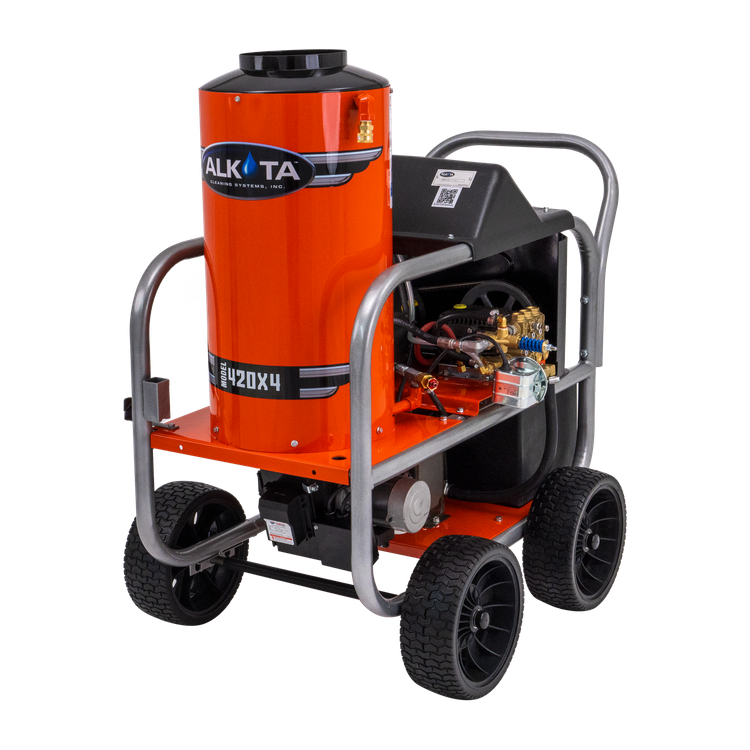
Alkota 420X4
420X4 — Electric Driven Oil Fired Hot Water Pressure Washer
Agricultural Equipment FAQ
Your Machinery Works for a Living. So Should the Machine That Cleans It.
Tell Alkota what machinery you operate, what contamination you deal with, how often you clean and whether you need a fixed or mobile system. We will help specify the equipment around the farm.

Marine Pressure Washers & Vessel Cleaning Equipment | Alkota UK
SALT NEVER TAKES A DAY OFF.
From working vessels to dockside machinery, marine equipment operates in an environment that constantly introduces salt, moisture, organic contamination and corrosion risk. Cleaning is part of keeping that environment under control.