
SALT NEVER TAKES A DAY OFF.
From working vessels to dockside machinery, marine equipment operates in an environment that constantly introduces salt, moisture, organic contamination and corrosion risk. Cleaning is part of keeping that environment under control.
The sea doesn’t just make equipment dirty.
It attacks it.
From working commercial fishing vessels to harbourside cranes and dry-dock engineering facilities, marine operations exist in an environment of constant saline assault, dense biofouling, and heavy mechanical contamination.
Salt spray dries into hygroscopic crystalline crusts that trap moisture and accelerate galvanic corrosion under paint coatings. Fish slime, biological oils, diesel soot, and heavy winch grease create acute slip hazards on steel decks. In this environment, washing is not an aesthetic exercise — it is an operational necessity to maintain deck safety, inspect critical mechanical fittings, and keep working vessels compliant between tides.
- Salt Encrustations: Soluble ionic crystals that draw atmospheric moisture onto steel.
- Fish Slime & Fats: Organic proteins and biological oils that create hazardous slip surfaces.
- Winch & Cable Grease: Heavy water-resistant lubricants mixed with abrasive salt sand.
- Marine Biofouling: Algae, weed, and barnacle crusts adhering to slipways and hulls.
The harbour is the workshop.
Diverse commercial maritime environments requiring industrial cleaning systems
Trawler decks, gutting tables, net handling machinery, and fish-hold sanitisation.
Concrete landing quays, fish market hardstanding, and forklift loading bays.
Steel hull washdown, marine growth blasting, propeller degreasing, and scale removal.
Tidal algae removal, slipway slime clearing, and floating pontoon maintenance.
Harbour mobile cranes, container reach stackers, capstans, and slew bearings.
Trawl winches, anchor windlasses, crane wire ropes, and hydraulic powerpacks.
Inboard diesel engine overhauls, gearbox degreasing, and pump rebuilds.
Power stations, offshore fabrication yards, and seaside processing works.
Salt is small. Its consequences aren’t.
After the sea, fresh water matters.
When seawater dries on vessel superstructures and deck fittings, it leaves behind microscopic sodium chloride and magnesium chloride crystals. These salts are hygroscopic — they continually absorb moisture from coastal air, creating localized electrolytic cells that accelerate galvanic oxidation beneath paint layers.
Because salt is highly water-soluble, high-flow freshwater rinsing is the only method to dissolve and carry salt ions away. Washing with salt water simply redeposits ions. Alkota high-flow washdown units deliver the volumetric freshwater capacity required to penetrate complex structural corners, hinge pins, and bolt threads.
*Removing salt contamination is one part of an effective maintenance regime. It does not replace sacrificial zinc anodes, protective marine coatings, or scheduled mechanical overhauls.
- High Flow Over Pressure: High L/min dissolves and flushes salt crystals out of seams without forcing water into sealed bearings.
- Cold Water Adequacy: Salt readily dissolves in cold fresh water; heating is reserved for grease and fish oils.
- Drainage Traps: Rinsing downward from top superstructure to prevent salt pooling in deck recesses.
More pressure is not always
more marine cleaning.
Marine vessels and dock machinery incorporate delicate substrate interfaces: epoxy antifouling coatings, gelcoat laminates, sacrificial anodes, rubber propeller shaft cutless bearings, and IP67-rated radar/navigation enclosures.
Blasting these components with extreme hydraulic pressure (300+ BAR) at close range can strip protective antifouling films prematurely, force water past waterproof electrical gland seals, or delaminate composite panels. Marine washdowns require calibrated pressure, wide-fan spray nozzles (25°–40°), and proper stand-off distances.
Always adhere to vessel manufacturer, coating specialist, and marine electronics cleaning guidelines.
- Gelcoat & Antifouling: Avoid point-blank 0° nozzles that can pit gelcoat or blister antifouling.
- Propeller Shaft Seals: Keep a minimum 40cm stand-off to avoid pushing water past lip seals into sterntubes.
- Bridge Electronics & Radars: Water is the tool; sensitive radomes and GPS antennas are not the target.
- Sacrificial Anodes: Clean zinc/aluminium anodes of loose scale without stripping mounting fasteners.
Salt rinses.
Grease needs more.
Salt & Superstructure Washdown
For daily vessel washdown, pontoon algae clearing, and quayside mud rinsing, high freshwater flow rate (20–30 L/min) provides the volumetric flushing capacity needed to dissolve soluble salt crusts rapidly with zero burner fuel overhead.
Winch Grease & Fish Oil Emulsification
When dealing with heavy water-resistant winch grease, hydraulic oil weeping on deck cranes, diesel exhaust soot, or biological fish slime in hold compartments, 85°C hot water liquefies hydrocarbons and animal fats instantly, restoring non-slip deck traction.
When the boat comes in, the cleaning starts.
An illustrative commercial fishing vessel turnaround between tides
01 / Land Catch
Discharge catch onto quayside fish market. Inspect deck, gutting bins, and conveyor chutes for gross organic residues.
02 / Gross Wash
Use high-flow freshwater lances to flush loose scales, fish waste, and salt spray down deck scuppers into dock containment sumps.
03 / Thermal Degrease
Deploy 85°C Alkota hot water across non-slip deck coatings, gutting tables, and winch blocks to dissolve stubborn fish oils.
04 / Winch Inspection
Clean trawl winches and capstans to inspect wire rope condition, hydraulic ram seals, and brake band linings for wear.
05 / Hold Sanitisation
Thermal washdown of insulated fish-hold bulkheads, ice storage sumps, and drainage lines prior to restocking fresh ice.
06 / Ready for Tide
Re-grease essential mechanical lubrication points and stage nets, ready for departure on the next high-water window.
A Mobile Marine System Needs a Water Plan
From quayside hose runs across pontoons to vessel deck washdowns, calculate freshwater demand, total mass, and quayside friction losses.
Standard dockside potable water supply with 3/8" high-pressure hose. An onboard 1,000L baffled buffer tank is advised if quay water flow is limited.
*Illustrative calculation based on theoretical continuous trigger pull and smooth-bore hydraulic friction tables.
The sea is not the drain.
What comes off the vessel matters.
In UK ports, harbours, and coastal boatyards, wash water containing petroleum hydrocarbons, toxic copper/biocide antifouling paint flakes, or heavy degreasers must not be discharged directly into the sea or municipal stormwater drains.
Professional maritime contractors utilise enclosed rotary surface cleaners fitted with perimeter vacuum recovery ports. Alkota water recovery systems extract wash water directly at the cleaning head, transferring trade effluent into onboard holding tanks or mobile oil-water separation systems.
Local harbour authorities enforce strict trade effluent regulations. Always establish containment and recovery controls prior to washdowns.
Enclosed stainless steel rotary cleaners that capture and extract dirty wash water instantly on slipways and docks.
Chemical-resistant containment barriers that prevent quayside runoff from entering harbour waters.
Multi-stage sediment and coalescing oil-water separation for self-contained shipyard operations.
When the cleaning can’t stay in the yard.
Fixed workshops vs mobile marine rigs.
Fixed Shipyard / Workshop Skid
Stationary electric or diesel hot-water skids housed in marine engineering workshops or dry-dock plant rooms, piped to permanent overhead boom drops with remote quayside operator control boxes.
Towable Marine Trailer Rig
A self-contained highway trailer carrying an industrial hot-water washer, 1,000L baffled freshwater tank, diesel engine, generator, and dual live stainless steel hose reels for long pontoon deployments.
Specify the System Around the Maritime Task
Select your vessel type, primary marine contaminant, and quayside configuration to determine the appropriate system architecture.
Alkota Towable Marine Trailer Rig
Equipped with a 1,000L baffled water tank, diesel hot-water skid with stainless steel wraps, engine drive, and dual live stainless hose reels for long pontoon deployments.
Maritime Operating Parameter Framework
Standard engineering parameters recommended for commercial vessels, shipyards, and dockside wash pads
Recommended Equipment for Marine & Harbourside Operations
Direct access to the Alkota engineering systems referenced in this field study.
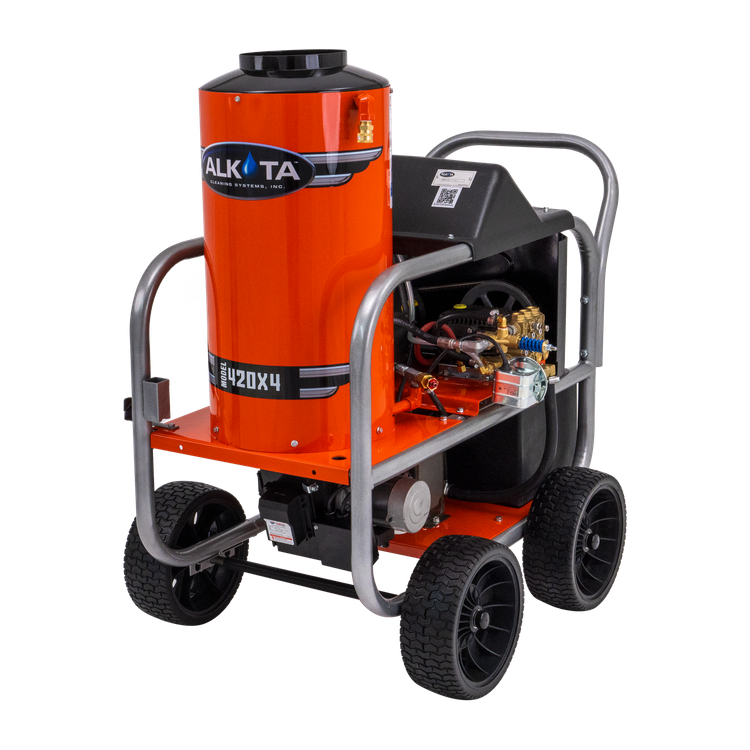
Alkota 420X4
420X4 — Electric Driven Oil Fired Hot Water Pressure Washer
Marine Equipment FAQ
The Sea is Hard on Equipment. Your Cleaning System Should Be Built for the Same Reality.
Tell us what you clean, where you operate, what contamination you face and how mobile the system needs to be. Alkota UK can specify the equipment around the marine environment.

Oilfield Pressure Washers & Industrial Cleaning Systems | Alkota UK
WHEN THE DIRT IS PART OF THE JOB, CLEANING BECOMES ENGINEERING.
Oilfield and heavy industrial equipment can encounter crude oil, grease, drilling mud, paraffin, bitumen, soil and other difficult contamination. The cleaning system has to be specified around the contamination, equipment and operating environment.